
Lower body workout planning gets confusing fast when you want both strength and tone, because the “right” plan depends on your equipment, your knees/back, and how often you can train.
If you’ve been doing random leg days and hoping for results, you’re not alone, a lot of people spin their wheels because they miss two basics: smart exercise selection (hinge, squat, lunge, calf, glute) and steady progression.
This guide gives you a practical lower-body template you can repeat, plus a quick self-check to pick the right variation, and a few “don’t do this” notes that save time and joints.
What “strength & tone” really means for lower-body training
“Tone” usually means muscle definition with a leaner look, and in real life that comes from building muscle while managing overall body fat, not from doing endless high-rep burn circuits.
Strength comes from progressively heavier or harder work, with solid technique and enough recovery to adapt. According to the American College of Sports Medicine (ACSM), resistance training with progressive overload supports increases in muscular strength and size when programmed consistently.
So the good news is you don’t need separate plans, you need one lower body workout that prioritizes big patterns, then adds targeted work where you want extra shape.
Why your lower body workout might not be “working”
When results stall, it’s rarely about motivation, it’s usually about the plan. These issues show up a lot:
- Too many exercises, not enough progression, you change movements weekly so your body never gets a clear signal to adapt.
- All squats, no hinge, glutes and hamstrings need hip-hinge work like RDLs or hip thrusts for balanced strength.
- Same weight forever, “tone” routines often live at a weight that’s comfortable instead of challenging.
- Form leaks, knees cave in, hips shift, low back takes over, you feel “worked” but the target muscles underperform.
- Recovery mismatch, hard leg sessions stacked with lots of running or long HIIT can make progress slower for many people.
If you recognize yourself in one or two bullets, that’s normal, fixing one constraint often unlocks everything else.
Quick self-check: choose the right plan variation
Use this checklist before you copy someone else’s “killer leg day.” If any item feels uncertain, dial the plan slightly simpler and build up.
- Equipment: bodyweight only, dumbbells/kettlebells, or barbell machines available?
- Time: can you train lower body 1x, 2x, or 3x per week?
- Joint comfort: do squats bother knees, do hinges bother lower back, or both feel fine?
- Goal emphasis: stronger lifts, glute growth, or balanced shape?
- Current level: can you control a slow 3-second lowering in a split squat without losing balance?
Rule of thumb: if you can do the movement with clean reps and still have 1–3 reps “in the tank,” you’re in a good training zone. If you grind, cheat, or feel sharp pain, adjust range, load, or choose a friendlier variation.
The lower body workout template (strength + tone)
This is the repeatable structure. Keep it for 6–10 weeks, then swap a few accessories if you feel stale.
Warm-up (6–10 minutes)
- Light cardio 2–3 minutes
- Hip mobility: 6–8 controlled reps each side (hip circles or 90/90 transitions)
- Activation: 1–2 sets of glute bridges and bodyweight squats, stop well before fatigue
Main lifts (pick one squat pattern + one hinge pattern)
These drive strength and shape. Rest 90–180 seconds between sets.
- Squat pattern: back squat, front squat, goblet squat, or leg press
- Hinge pattern: Romanian deadlift, hip thrust, trap-bar deadlift, or cable pull-through
Assistance lifts (unilateral + posterior chain)
These clean up imbalances and add “tone” where most people want it.
- Split squat or reverse lunge
- Hamstring curl (machine/band) or single-leg RDL
Finishers (optional, short and targeted)
- Calf raises (standing or seated)
- Glute med work: lateral band walks or cable abductions
- Core: dead bug or side plank, keep it crisp
Sample workouts + progression (with a practical table)
Below are two common setups. If you train legs twice weekly, alternate A and B. If once weekly, run A for 6–10 weeks, then switch to B.
| Workout | Exercise | Sets x Reps | Notes |
|---|---|---|---|
| A (Squat focus) | Goblet squat or back squat | 4 x 5–8 | Stop 1–2 reps shy of form breakdown |
| A | Romanian deadlift | 3 x 6–10 | Feel hamstrings, keep spine neutral |
| A | Reverse lunge | 3 x 8–12 / side | Longer step often feels kinder on knees |
| A | Calf raise | 3 x 10–15 | Pause at top and bottom |
| B (Glute/hinge focus) | Hip thrust | 4 x 6–10 | Full lockout without low-back arch |
| B | Leg press or front squat | 3 x 8–12 | Controlled depth, steady tempo |
| B | Hamstring curl | 3 x 10–15 | Slow lower, no hip lift off pad |
| B | Side plank | 2–3 x 20–40s | Ribs down, breathe |
Progression that works: keep the same exercises and add either 1 rep per set each week, or 2.5–10 lb when you hit the top of the rep range with clean form. This is where many “tone” plans quietly fail, because nothing gets harder.

If you prefer a simpler method, use an RPE scale: most working sets land around RPE 7–9 (challenging, but not an all-out max), especially on the main lifts.
Form cues that protect your knees and back
You can do a lower body workout for years, but if reps feel “off,” your joints pay the bill. A few cues fix a lot.
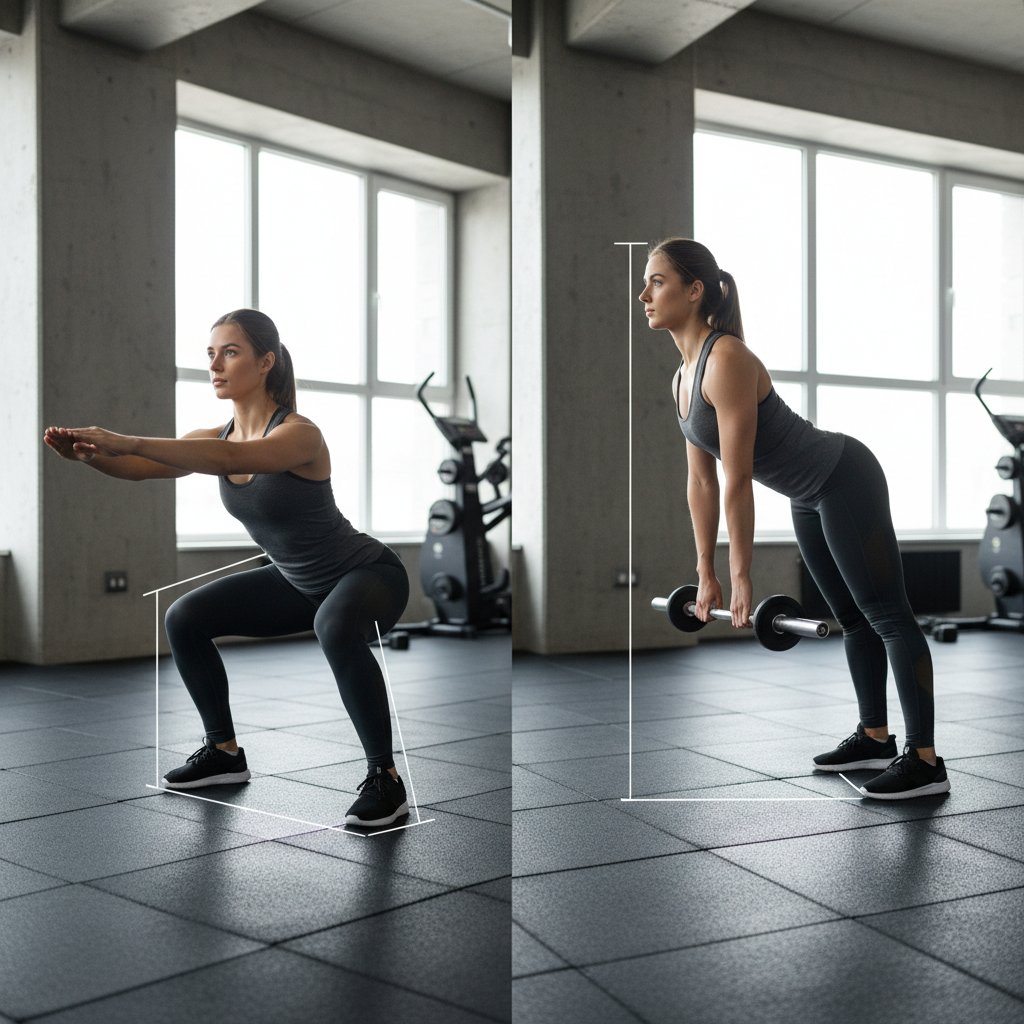
Squat pattern cues
- Tripod foot: big toe, little toe, heel stay grounded.
- Knees follow toes: mild forward travel is normal, collapsing inward is the red flag.
- Depth you own: go as low as you can control without butt-wink or heel lift.
Hinge pattern cues
- Hips back, think “close a car door with your hips.”
- Shins fairly vertical, you should feel tension in hamstrings.
- Neutral spine, ribcage stacked over pelvis, no aggressive arching.
If pain shows up, don’t push through to prove a point, many cases improve with smaller range of motion, lighter load, slower tempo, or a different variation, and when in doubt it’s reasonable to consult a qualified coach or clinician.
Mistakes that waste effort (and what to do instead)
- Chasing soreness: soreness is not a score. Instead, track reps, loads, and technique quality.
- Doing only high reps: higher reps can help, but many people need some heavier work to build real strength. Mix 5–8 reps and 8–15 reps.
- Skipping unilateral work: split squats and lunges look basic, but they’re the fastest way to expose weak links.
- Too much cardio on leg days: keep hard intervals away from heavy lower sessions when possible, or accept slower strength gains.
- Ignoring nutrition: “tone” usually improves when protein intake and overall calories match your goal. According to the Dietary Guidelines for Americans, healthy eating patterns support overall health, and for body composition goals you may want individualized advice from a registered dietitian.
When to get professional help
Many people can run this plan safely, but certain situations deserve extra eyes:
- Sharp, escalating, or persistent joint pain, especially if it affects daily walking or sleep
- History of major knee, hip, or back injury, or surgery with restrictions
- Pregnancy or postpartum return to lifting, where modifications may be needed
- Unexplained swelling, numbness, or radiating pain
A physical therapist, certified personal trainer with relevant experience, or sports medicine clinician can help you choose variations and load progressions that fit your body and history.
Key takeaways + how to start this week
If you want strength and tone, your plan does not need to be fancy, it needs to be repeatable. Build your lower body workout around a squat pattern and a hinge pattern, add unilateral work, then progress slowly and on purpose.
This week, pick Workout A and Workout B, schedule them 2–3 days apart, and write down your loads and reps. Next week, add a small amount of weight or 1–2 reps where form stays solid, that simple loop beats random “leg burn” sessions most of the time.
FAQ
How many days per week should I do a lower body workout?
Twice weekly works well for many people because you get enough practice and volume without crushing recovery. Once weekly can still work, it just tends to progress slower, three times weekly fits some lifters but usually needs lighter daily volume.
Can I get toned legs without heavy weights?
Often yes, but you still need progressive overload, meaning the work must become harder over time. That can come from more reps, slower tempo, harder single-leg variations, or limited rest, not only heavier dumbbells.
What if squats hurt my knees?
Try reducing depth, using a goblet squat to keep torso more upright, or switching to a leg press with controlled range. If pain persists or feels sharp, it’s smart to consult a professional rather than “push through.”
Are hip thrusts better than squats for glutes?
Hip thrusts typically load the glutes hard at the top position, while squats train glutes plus quads through a longer range. Many people get the best overall development by keeping both patterns somewhere in the week.
How long until I see results?
Strength can improve within a few weeks from better coordination and technique, visible “tone” often takes longer and depends a lot on nutrition, sleep, and consistency. A realistic approach is to judge progress over 6–10 weeks, not 6–10 days.
Should I do cardio after leg day?
Light cardio after training is usually fine. Hard intervals right after heavy lifting can be tougher to recover from for many people, so consider separating them by several hours or placing intervals on another day.
What’s the best rep range for strength and tone?
A mix works well: heavier sets around 5–8 reps for the main lift, then 8–15 reps for assistance work. If all sets feel easy, the rep range is not the issue, the load or effort level is.
If you’re trying to simplify your training, a repeatable lower body workout template plus a basic progression rule is usually the most “set it and forget it” approach, and if you want, tell me your equipment and weekly schedule and I can suggest the cleanest A/B version to start with.